
Can Employment Network Help My Adult Child With Autism Find Work?

Families often contact Employment Network of Southwest Florida with a direct and important question:
“My adult son has autism and wants to work. Can you help him?”
Sometimes the person is approaching adulthood and thinking about a first job.
Sometimes they finished school several years ago but have not found the right opportunity. Other families want to understand whether full-time employment is possible or what job-placement support actually means.
The short answer is that Employment Network provides employment services for eligible adults with disabilities, including adults with autism.
What that support looks like—and where it begins—deserves a clearer explanation.

What Does “Help Finding Work” Actually Mean?
Employment support is not simply handing someone a list of openings.
Before a productive job search can begin, it helps to understand what the person wants from employment, what experience they already have and what assistance may be useful.
Depending on individual eligibility and program requirements, Employment Network’s services may include:
Career counseling.
Employment-readiness support.
Résumé and application assistance.
Interview preparation.
Help identifying employment opportunities.
Benefits counseling.
Workplace problem-solving.
Ongoing employment support after hiring.
Not every client will need every service. One person may already have a résumé but need interview practice. Another may need help identifying an employment goal.
The process is personalized because employment goals and support needs are different for every individual.

Is Employment Network a Staffing Agency?
Employment Network is an employment-services organization for eligible adults with disabilities. It is not a temporary staffing agency and does not employ clients on behalf of another business.
The team helps clients prepare for and pursue appropriate employment opportunities. Employers review candidates and make their own hiring decisions.
This distinction is important because job placement support cannot guarantee:
A particular job.
Employment with a specific company.
A full-time schedule.
A particular wage.
An immediate hiring date.
Employment support strengthens the process. The final hiring decision belongs to the employer.
What Does Job Placement Support Include?
The phrase “job placement” can sound as though an organization assigns someone to a job. In practice, it is a more collaborative process.
Job-placement support may involve:
Identifying job leads related to the person’s skills and goals.
Helping complete applications.
Preparing for interviews.
Communicating with potential employers when appropriate.
Supporting onboarding or the transition into a position.
Helping address workplace questions after hiring.
The job seeker remains an active participant. Their interests, decisions and effort are part of the process.
The goal is not simply to obtain any available position. It is to pursue an employment opportunity the person can realistically perform and maintain.
Can Full-Time Employment Be the Goal?
Some adults with autism want to work full time. Others prefer part-time employment or may want to begin with fewer hours.
Full-time work can be an employment goal, but the appropriate goal depends on the individual, available opportunities and applicable program requirements.
Questions that may help shape the goal include:
How many hours does the person want to work?
What schedule can they manage consistently?
What transportation is available?
Do they currently receive disability benefits?
What previous work, volunteer or school-based experience do they have?
What type of position are they interested in pursuing?
Part-time work is not automatically a temporary or lesser outcome. Full-time work is not automatically the correct objective for everyone. A useful employment plan reflects the individual rather than applying the same expectation to every job seeker.
Can a Parent or Caregiver Make the First Contact?
Yes. Employment Network welcomes inquiries from parents and guardians seeking guidance for an adult family member with a disability.
Parents often help locate services, organize information, provide transportation and encourage the person through unfamiliar situations.
At the same time, employment is ultimately about the adult job seeker. Whenever possible, the individual should participate in conversations about:
Whether they want to work.
The kind of work they would like to explore.
Their preferred schedule.
Their employment concerns.
Their personal goals.
The support they believe would be helpful.
A family can open the door to the conversation while helping the individual develop a stronger voice in the process.
Does Someone Need to Know Exactly What Job They Want?
No. Career counseling exists in part to help people clarify their employment direction.
A person may know that they want to work without knowing what position to pursue. They may have several interests but little experience. They may also have an idea based on a favorite activity without knowing what that job looks like in an actual workplace.
An employment conversation can help distinguish between:
An interest and an employment goal.
A task someone enjoys and the complete responsibilities of a job.
A preferred workplace and the opportunities currently available.
Skills the person already has and skills that may need development.
It is reasonable for the first employment goal to change as the person learns more.
What If the Person Has Never Worked Before?
Previous employment is helpful, but it is not the only way to identify abilities.
Experience can come from:
School activities.
Volunteer responsibilities.
Internships or work-based learning.
Household routines.
Community participation.
Clubs, hobbies or personal projects.
Helping a family member or local organization.
These experiences may demonstrate reliability, attention to detail, communication, organization, task completion or the ability to follow a routine.
An employment professional can help the individual recognize and describe these abilities in ways that are relevant to a job search.
Does Support End When Someone Gets Hired?
Getting hired is an important outcome, but starting the job introduces a new set of responsibilities.
An employee may have questions about:
Learning new duties.
Understanding feedback.
Communicating with a supervisor.
Managing a changing schedule.
Resolving a workplace concern.
Becoming more independent in the position.
Preparing for additional responsibilities.
Employment Network offers ongoing employment support to help eligible clients address workplace issues, maintain employment and continue developing professionally.
The objective is not only to reach the first day. It is to help create the conditions for longer-term employment success.

What Can Families Expect From the First Conversation?
The initial conversation helps Employment Network understand why the individual or family is reaching out.
Topics may include:
The adult’s interest in working.
Previous work, school or volunteer experience.
General employment goals.
Current disability benefits, if applicable.
Vocational Rehabilitation involvement, if applicable.
Transportation considerations.
Areas where the person may want employment support.
Questions about available programs.
Employment Network can then explain its services and the general next steps. Eligibility and available services vary by individual and program.
Questions about residency, required documents, specific funding or other eligibility details should be discussed directly with the team because the answer may depend on the person’s circumstances.
Frequently Asked Questions
Does Employment Network work only with people who have autism?
No. Employment Network provides employment services for eligible adults with different disabilities. Autism is one of the disabilities represented among the individuals and families the organization may serve.
Is Employment Network a medical or therapy provider?
No. Employment Network focuses on career counseling, employment preparation, benefits guidance, job-search support and ongoing workplace support. It does not diagnose or treat autism or any medical condition..
Does Employment Network guarantee a job?
No organization can guarantee that a particular employer will hire an applicant. Employment Network helps eligible clients prepare for and pursue employment. Employers make the final hiring decisions.
Can a family member contact Employment Network?
Yes. Parents and guardians seeking guidance may contact Employment Network. The adult job seeker should participate in the employment process whenever possible.
Can Employment Network help after someone is hired?
Yes. Ongoing employment support is one of Employment Network’s core services. Available support depends on individual eligibility and program requirements.
Have a Question About Employment Services?
If your adult son, daughter or family member has autism and is interested in working, Employment Network of Southwest Florida can explain its services and help identify the appropriate next step.
You can begin by sharing what the person hopes to accomplish and what kind of employment support you are seeking.
Call 239-452-4020 or contact Employment Network through the website.
Employment Network serves eligible adults with disabilities in Naples, Collier County and the surrounding Southwest Florida community. Available services depend on individual eligibility and program requirements.
About Employment Network of Southwest Florida
Founded in 2013, Employment Network of Southwest Florida helps adults with disabilities pursue meaningful employment and long-term workplace success. ENSWFL is a certified vendor of Vocational Rehabilitation and an Approved Member of the American Dream Employment Network.
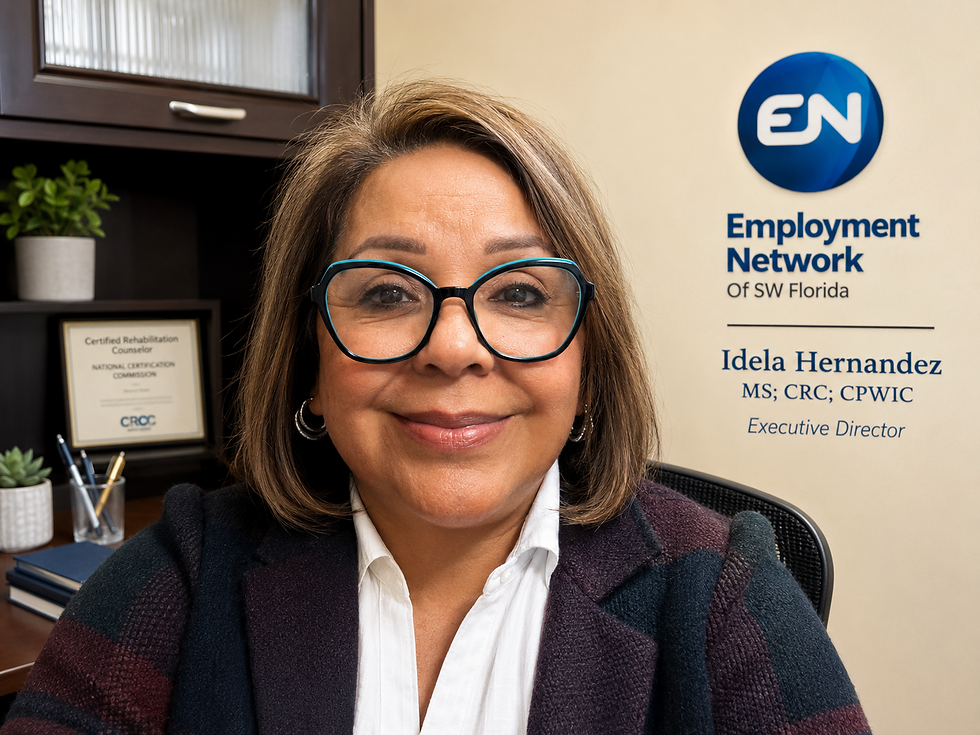
Executive Director Idela Hernandez brings more than 20 years of experience helping individuals with disabilities return to work and pursue greater self-sufficiency. She holds a BS in Human Services from Florida Gulf Coast University and an MS in Rehabilitation Counseling from the University of Kentucky. Idela is a Certified Rehabilitation Counselor (CRC) and Community Partner Work Incentives Counselor (CPWIC).
Contact Information:
Email: info@enworks.org
Phone: 239-452-4020
Office: 3050 Horseshoe Drive North, Suite 158, Naples, FL 34104
Services: https://www.enworks.org/services
Appointments are required.
Disclaimer: This article provides general educational information and does not constitute medical, legal or individualized benefits advice. Eligibility, employment goals and available services vary. Questions about diagnosis or treatment should be directed to a qualified healthcare professional. Questions about legal rights should be directed to an appropriate legal or government resource.

Comments