
Returning to Work With a Disability in Naples, FL

Your Ability to Work Changed. Your Experience Still Matters.
A person may spend years building a career before an accident changes what they can physically do.
Someone living with the effects of a brain injury may want to work again but feel uncertain about memory, concentration or pace.
A person who experienced cancer or another serious illness may be ready to consider employment, even if returning to the same schedule or responsibilities no longer feels realistic.
The circumstances are different, but the question is often the same:
“What can work look like for me now?”
Living with a disability after an illness or injury may change someone’s employment path. It does not erase their experience, abilities or desire to contribute.
For eligible adults with disabilities in Naples and Southwest Florida, employment support can help make the next step clearer.

This Is an Employment Conversation
Employment Network of Southwest Florida does not provide medical treatment, therapy or physical rehabilitation. Our work begins with employment.
An employment conversation may explore questions such as:
Can I continue working in my previous field?
Would a different position be more appropriate?
What skills from my past experience can I still use?
How should I address time away from work?
Would a different schedule or work environment be more sustainable?
How could employment affect my disability benefits?
What support may be available after I am hired?
Health decisions should remain between the individual and qualified healthcare professionals. Employment Network focuses on helping eligible adults prepare for, pursue and maintain employment.
An Acquired Disability Can Change the Plan
Some people have lived with a disability throughout their lives. Others acquire a disability after they have already worked, developed professional skills and established a career.
An acquired disability may result from:
An accident or physical injury.
A brain injury.
A neurological condition.
A serious illness.
Cancer or the lasting effects of treatment.
Another condition that produces long-term physical or cognitive limitations.
A diagnosis or medical event alone does not determine eligibility for employment services. Program eligibility depends on the individual’s circumstances and applicable requirements.
The important employment question is how the disability currently affects the person’s ability to prepare for, obtain or maintain work.
Your Work History Has Not Disappeared
After a major change in health or ability, people sometimes feel that they must start over completely.
That is not always the case.
Previous employment may have helped someone develop:
Industry knowledge.
Customer-service experience.
Organization.
Time management.
Written or verbal communication.
Technical abilities.
Problem-solving skills.
Supervisory experience.
Reliability and workplace awareness.
The person may no longer be able to perform every responsibility from a previous job, but many skills may transfer to another position or industry.
An employment plan can examine both sides of the situation:
What has changed?
What experience and ability remain?
Both questions matter.
Returning to Work May Mean Taking a Different Path
Returning to employment does not always mean going back to the same job.
For some people, an appropriate path may be returning to a familiar field with different duties, hours or working conditions.
Others may use transferable skills in a different occupation.
Some may decide that a completely new direction is more realistic.
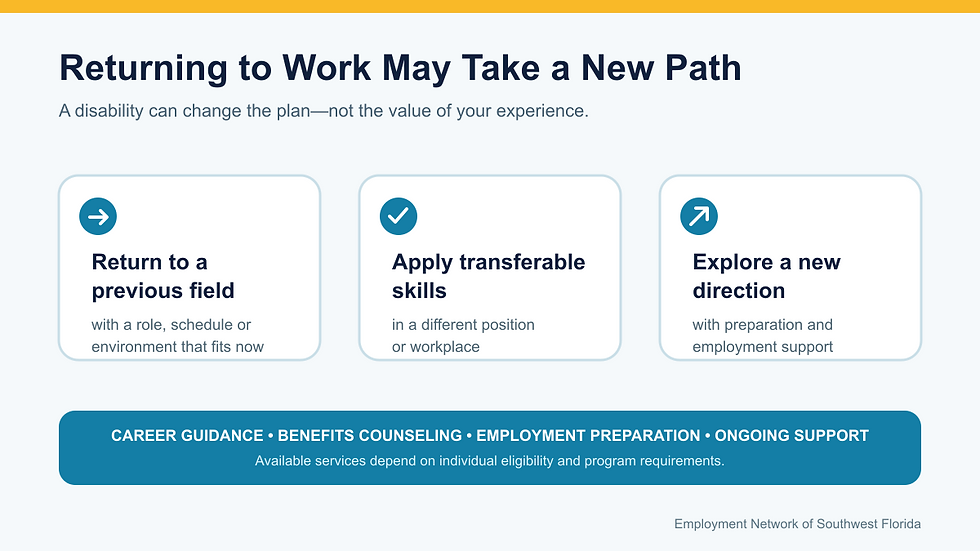
Returning to a previous field
The person continues using their industry experience but pursues a position with responsibilities that better reflect their current abilities.
Applying transferable skills
The person identifies skills developed in a previous career and applies them in a different position or workplace.
Exploring a new direction
The person considers another type of work with preparation, career guidance and employment support.
Changing direction does not diminish the value of someone’s previous career. It can be a practical response to a major life change.
What About a Gap in Employment?
Time away from work is common after a serious illness or injury.
Still, many people feel uncomfortable when they see that gap on a résumé or anticipate questions during an interview.
Employment preparation can help a job seeker:
Organize their previous experience.
Update their résumé.
Highlight current strengths.
Identify relevant transferable skills.
Prepare a concise explanation for time away.
Practice answering interview questions.
Refocus the conversation on qualifications and readiness to contribute.
A person does not necessarily need to share detailed private medical information during a job interview.
An employment professional can help the individual prepare a truthful and appropriate response while keeping the focus on work.
Questions about legal disclosure obligations or employment rights should be directed to an appropriate legal or government resource.
Start With What Is Realistic Now
A previous career may have involved long shifts, physical labor, extensive driving, constant multitasking or a fast-paced environment.
After acquiring a disability, the same conditions may no longer be practical.
A current employment plan may consider:
Physical demands.
Concentration and task complexity.
Work pace.
Schedule and number of hours.
Transportation.
Communication preferences.
Workplace environment.
Previous experience.
Current interests.
Employment goals.
This is not about concentrating only on limitations. It is about developing a plan the person has a reasonable opportunity to maintain.
A realistic goal can still be meaningful and ambitious.
Preparing to Reenter the Workforce
Returning to work may involve more than submitting applications.
Depending on individual eligibility and program requirements, employment support may include:
Career counseling.
Reviewing employment goals.
Identifying transferable skills.
Exploring possible occupations.
Résumé and application assistance.
Interview preparation.
Finding relevant job leads.
Preparing for a new workplace routine.
Benefits counseling.
Ongoing support after hiring.
Not every person will need every service. Support should reflect the individual’s situation rather than follow an identical process for every job seeker.
Employment Support Can Continue After Hiring
Receiving a job offer is an important step, but returning to work may bring new questions.
A person might need time to adjust to:
A new schedule.
Different responsibilities.
New technology or processes.
Communication with a supervisor.
Changes in stamina or concentration.
Workplace expectations.
Feedback and performance conversations.
Employment Network offers ongoing employment support to help eligible clients address workplace concerns, maintain employment and continue developing professionally.
Long-term success may require adjustments and problem-solving. Asking for support does not erase the progress already made.
How Families Can Support the Return-to-Work Process
Family members often play an important role after an illness, accident or major change in ability.
They may help locate services, organize information, provide transportation or encourage someone who is uncertain about trying again.
Helpful family support can include:
Listening to the person’s employment goals.
Recognizing the experience they already have.
Encouraging realistic exploration without creating pressure.
Helping gather employment and benefits information.
Supporting the person’s participation in appointments.
Allowing the individual to make decisions about their employment path.
Returning to work should not become something decided entirely for the person. Their goals, concerns and choices remain central to the process.
.
Ready to Consider Working Again?
If you are living with a disability after an illness, injury or major change in your abilities, your employment path may look different than it did before.
That does not mean your experience no longer matters.
Employment Network of Southwest Florida helps eligible adults with disabilities explore employment options, prepare for the job search and work toward long-term employment success.
Call 239-452-4020 or contact us through our website to learn more about available services and general eligibility requirements.
Employment Network serves eligible adults with disabilities in Naples, Collier County and the surrounding Southwest Florida community. Available services depend on individual eligibility and program requirements.
About Employment Network of Southwest Florida
Founded in 2013, Employment Network of Southwest Florida helps adults with disabilities pursue meaningful employment and long-term workplace success. ENSWFL is a certified vendor of Vocational Rehabilitation and an Approved Member of the American Dream Employment Network.
Executive Director Idela Hernandez brings more than 20 years of experience helping individuals with disabilities return to work and pursue greater self-sufficiency. She holds a BS in Human Services from Florida Gulf Coast University and an MS in Rehabilitation Counseling from the University of Kentucky. Idela is a Certified Rehabilitation Counselor (CRC) and Community Partner Work Incentives Counselor (CPWIC).
Contact Information:
Email: info@enworks.org
Phone: 239-452-4020
Office: 3050 Horseshoe Drive North, Suite 158, Naples, FL 34104
Services: https://www.enworks.org/services
Appointments are required.
Disclaimer: This article provides general educational information and does not constitute medical, legal or individualized benefits advice. Eligibility, employment goals and available services vary. Questions about diagnosis or treatment should be directed to a qualified healthcare professional. Questions about legal rights should be directed to an appropriate legal or government resource.


Comments